


Ever since meeting Jiro Katayama in December 2024, I’ve found myself returning to his work again and again.
Over the course of 2025, I ended up producing a series of pieces on Otsuka Lotec—starting with a video on the Model 5 Kai following its launch in January, which went on to reach over 74,000 views. That was followed by a visit to Katayama-san’s workshop, and later, a closer look at the Model 6.
Somewhere along the way, it became clear that this wasn’t just a personal fascination. There was a growing sentiment among collectors and enthusiasts worldwide: Otsuka Lotec was doing something genuinely different.
So when I was invited to attend the exhibition of the Model 8 in Harajuku, it wasn’t really a question. I wanted to see what he had done next—and, perhaps more importantly, to observe the man again.
One of the most remarkable things about Katayama’s work is not just the watches themselves, but the pace at which they are being created.
When I first interviewed him, he mentioned a goal of releasing one watch a year. At the time, it sounded ambitious. Now, it feels almost conservative.
When I first met him, the models available were the 5, 6, and 7.5. Shortly after, the 5 Kai was introduced. Then came the announcement of the Model 9—a higher-end tourbillon that sits in a different category altogether. And now, in 2026, we have the Model 8.
If you trace the full arc—from the early prototypes (Models 1 through 4), to the first commercial Model 5, and everything that followed—you begin to see something else entirely: not just output, but evolution. Each watch is a step forward, both mechanically and philosophically.
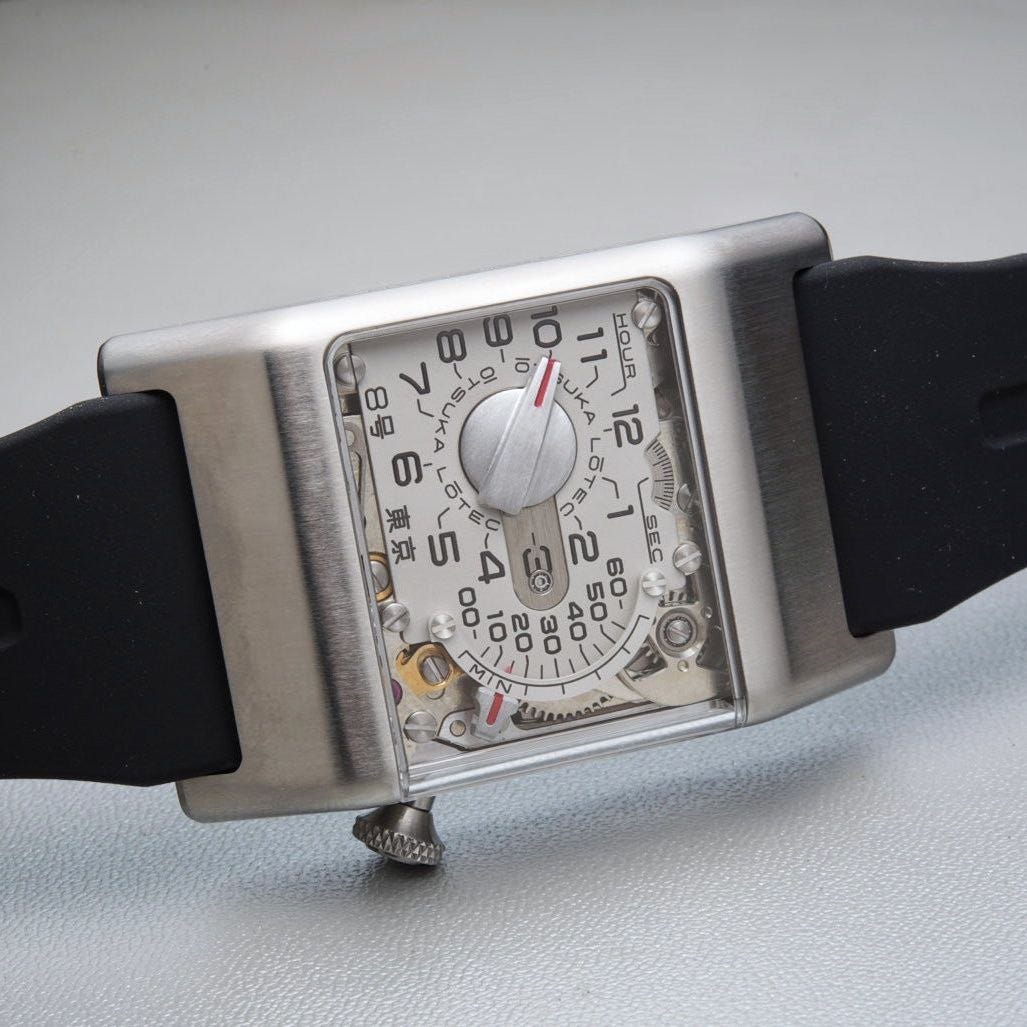
The Model 8 marks a clear shift in both form and execution.
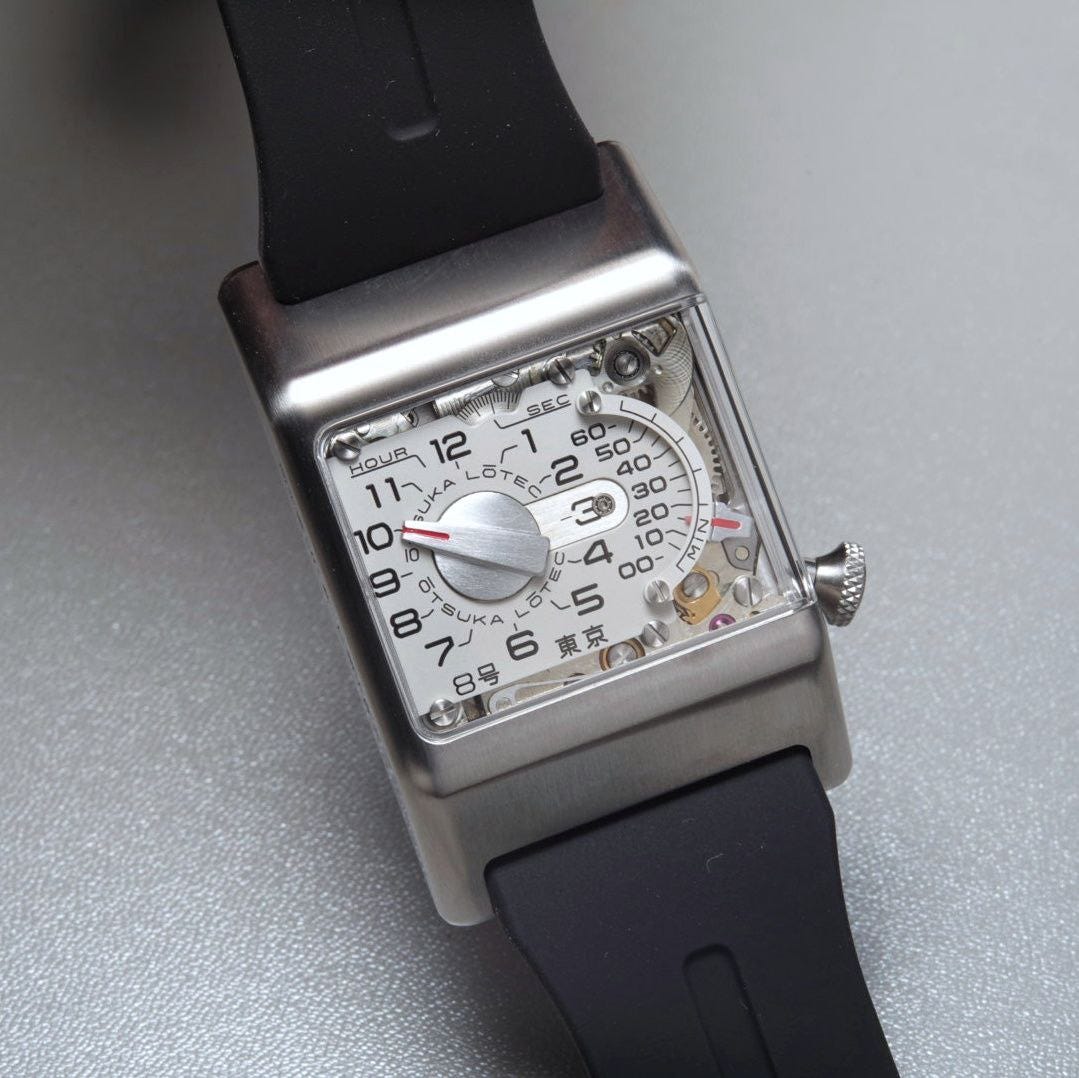
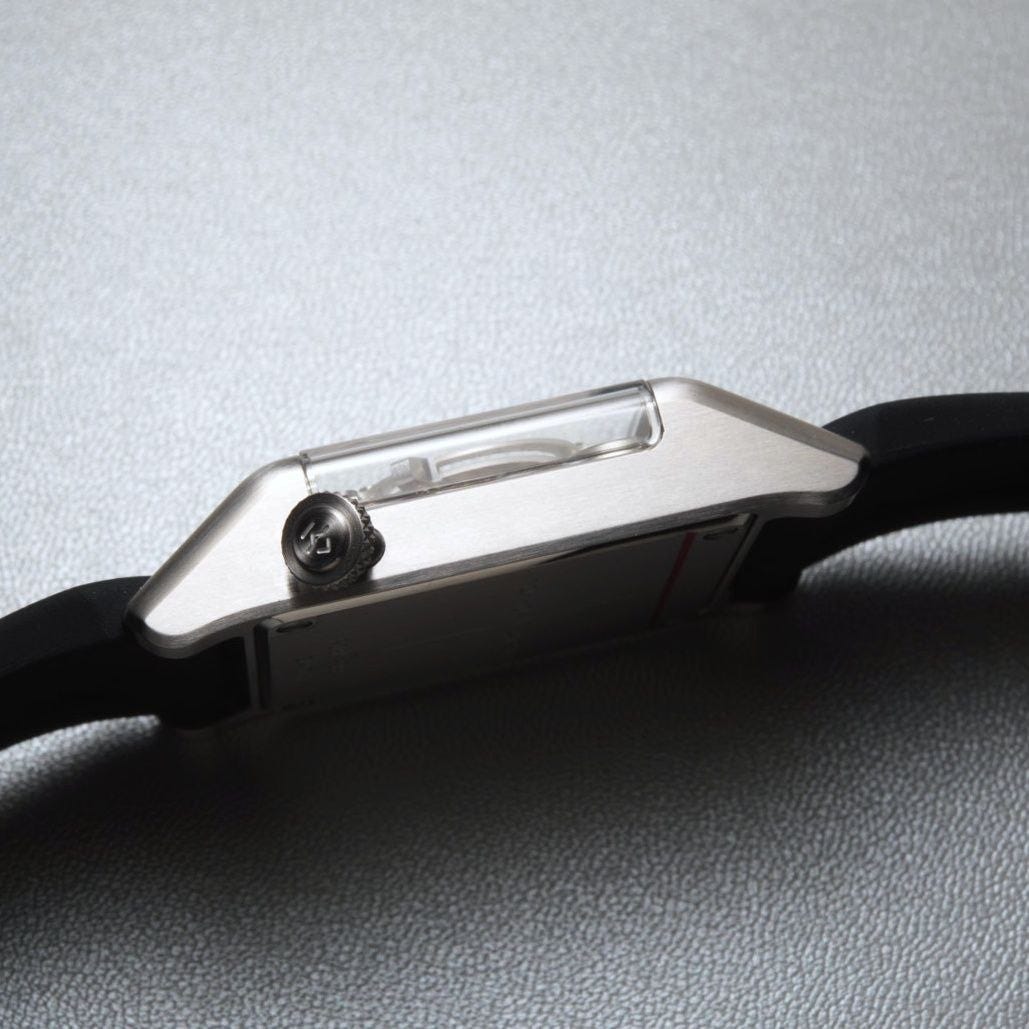
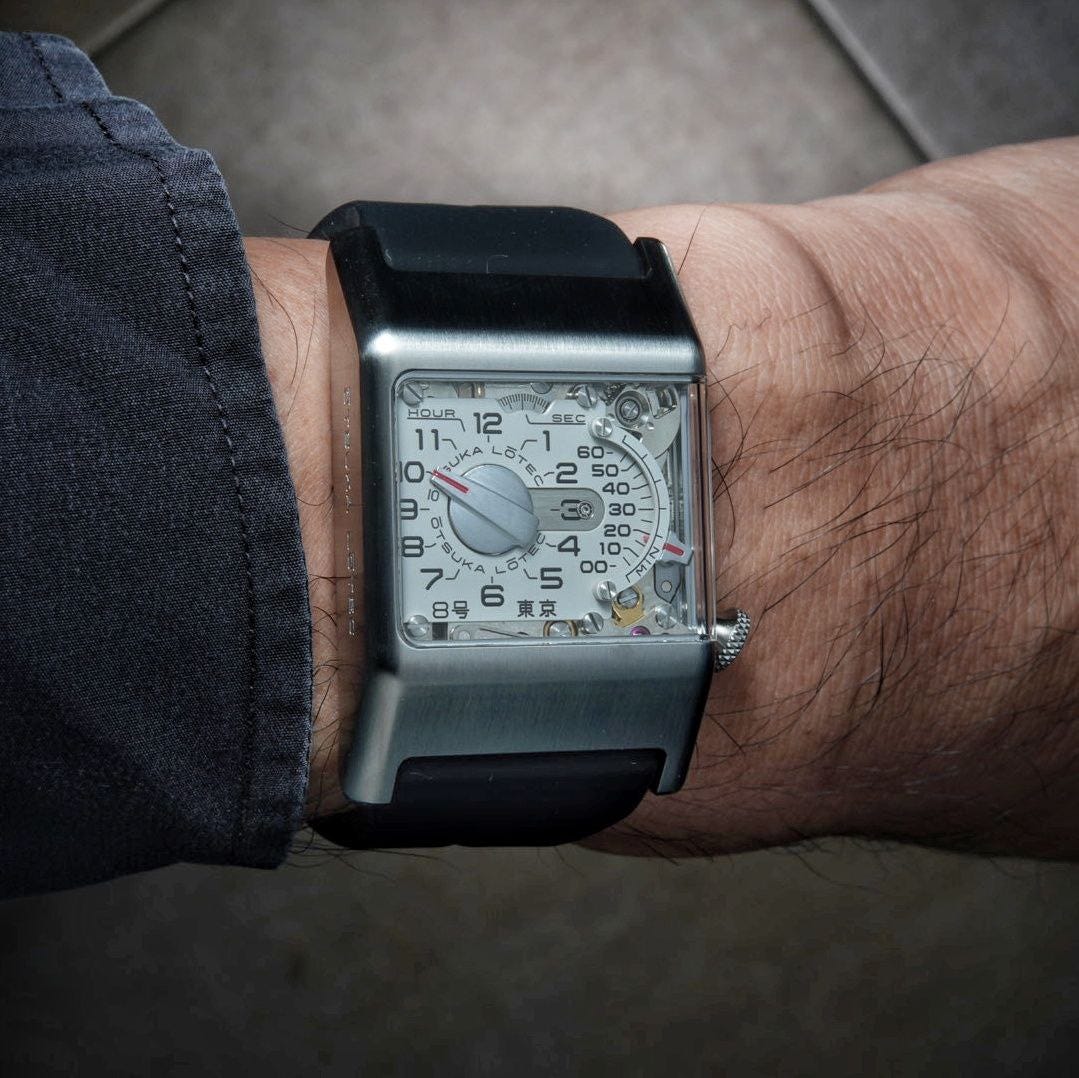
For the first time, the case adopts a square profile—though not in the conventional sense. The sides are sloped, softening the geometry and making it surprisingly ergonomic. It presents as a square, but wears with a kind of mechanical fluidity that aligns perfectly with Katayama’s design language.
Mechanically, it continues his exploration of alternative time display—but refines it.
Hours are shown on the left, rendered as a large disc that resembles a control knob on a piece of industrial equipment. Minutes sit on the right, displayed via a retrograde system. But unlike earlier models—such as the Model 6, where the hand snaps back too quickly for the eye to follow—the Model 8 introduces a flywheel.
The result is subtle, but transformative.
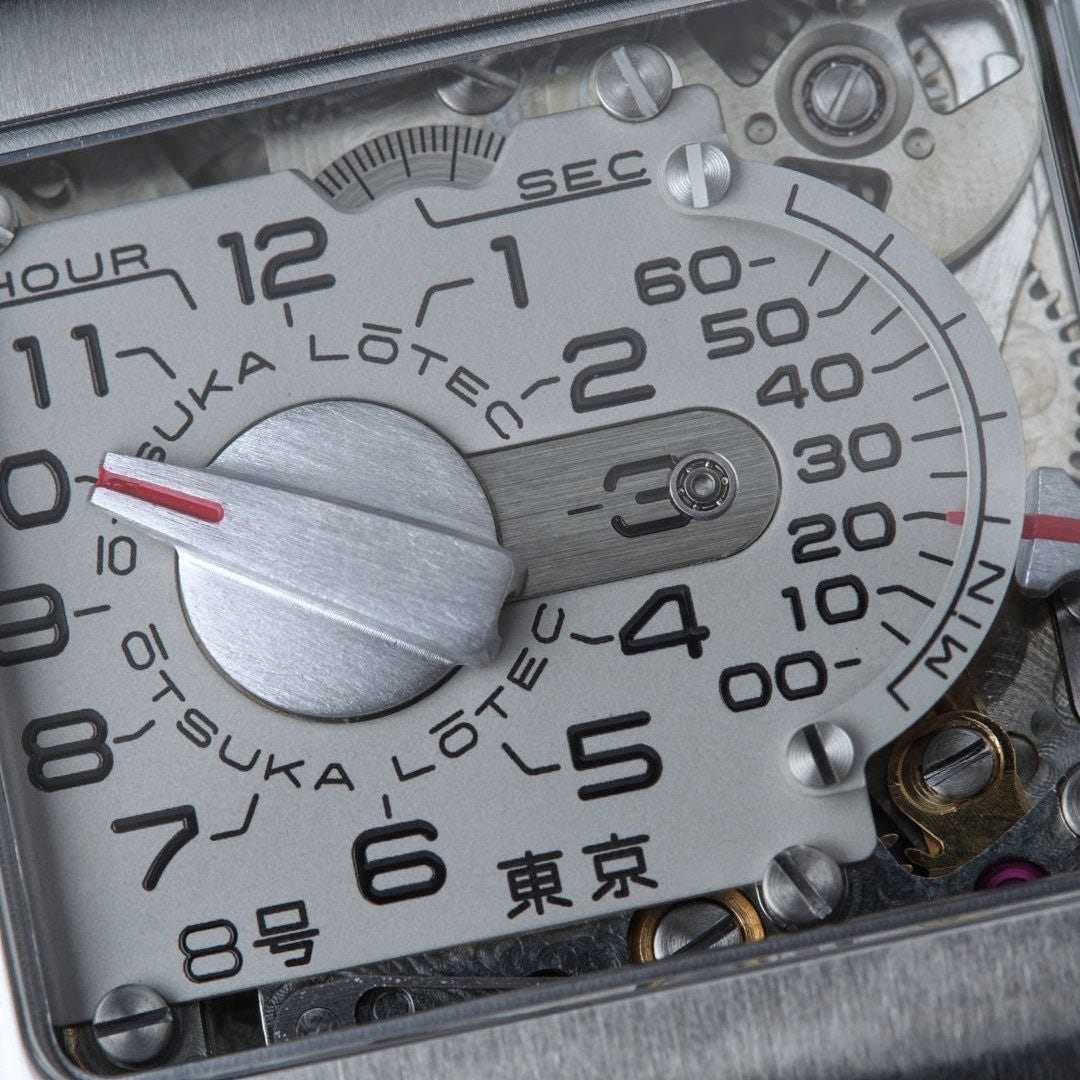
Instead of a sudden reset, the retrograde motion slows just enough to become visible. You don’t just register the jump—you see it happen. It adds a sense of rhythm, almost like a mechanical breath.
This also makes it, in my view, the most legible Otsuka Lotec to date.
The separation of hours and minutes—left and right—combined with their increased scale, makes reading the time immediate.


By comparison, the Model 6 requires a moment of adjustment. The 5 Kai and earlier pieces, while visually compelling, compromise slightly on clarity due to their more compact displays.
The Model 8 doesn’t.
Inside, however, the simplicity is deceptive.
Katayama explained that achieving this level of clarity required a significant increase in mechanical complexity. Coordinating two jumping systems—the hour and the retrograde minute—along with the addition of the flywheel, demands careful calibration and extensive adjustment during assembly.
But what’s interesting is how he frames that challenge.
Over time, through building each successive model, he has learned not just to make things more complex—but to make them stronger and more refined. The Model 8 reflects that accumulated knowledge. It is, in many ways, a distillation of everything he has learned since his earliest prototypes.
It still builds on his modular approach—originally developed on a Miyota base—but now executed with far greater control and confidence. (The Model 9, notably, stands apart with a fully in-house movement.)
Even details like the use of Minabea Mitsumi ball bearings—among the smallest in the world, previously seen in the Model 5 Kai—point to a continuity of ideas, carried forward and improved.
On the wrist, the watch feels almost imagined.
There’s a distinctly retro-futuristic quality to it—the kind of object you could picture in a 1960s vision of the future. All machinery, all intention. Not designed to resemble the past, but to suggest a different path forward.
Seeing Katayama again was, in itself, a pleasure.
Over the past year, we’ve built something of a quiet understanding. I get the sense that he recognises the effort—that I’ve come to Japan more than once to see his work, to understand it properly, and to document it. And in return, there’s a certain openness, even if understated.
It’s not a loud relationship. But it feels real.
The Model 8 is priced at approximately ¥990,000 (around $6,300 USD).
And at that level, it becomes difficult to ignore.
Because what you’re getting here is not just a watch, but a fully formed idea—mechanically original, visually distinct, and produced in extremely limited quantities by a single independent maker working at the height of his momentum.
In a landscape where independent watchmaking at this level often commands significantly higher prices, the Model 8 doesn’t just represent value—it quietly disrupts expectations of what that value should look like.
Of course, acquiring one is another matter entirely. Like the rest of the collection, it is available via lottery—and demand continues to exceed supply.
To own an Otsuka Lotec is, in itself, a rare thing.
If you’re considering the brand today, the lineup offers a surprising range: the Model 5 Kai, Model 6, Model 7.5, and now the Model 8—each with a distinct personality. And for those able to stretch further, the Model 9 exists in a category of its own.
As for me, the Model 8 is deeply tempting.
It wears well. It reads clearly. And more than anything else—it feels like an idea made tangible.
There are watches that tell the time.
And then there are watches like this—ones that make you stop, look again, and wonder how someone chose to see time differently in the first place.